


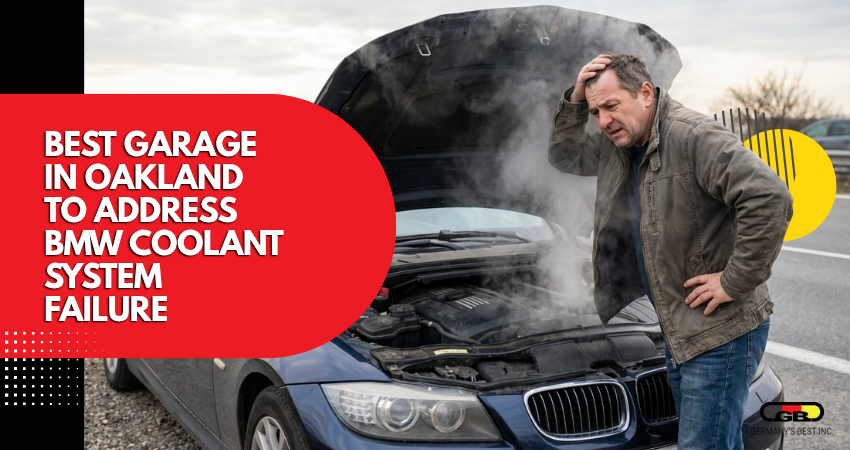
Your BMW’s cooling system is one of the most important — and unfortunately, one of the most failure-prone — systems on the vehicle. Unlike German-engineered metal components that last for decades, many of the cooling system parts on modern BMW models are made of plastic to reduce weight and cost. Over time, these plastic components become brittle, crack under thermal stress, and begin to leak. At Germany’s Best, INC. in Oakland, California, our BMW specialists have repaired hundreds of cooling system failures across a wide range of BMW models, and we understand what it takes to restore your cooling system to factory reliability.
Why BMW Cooling Systems Are Prone to Failure
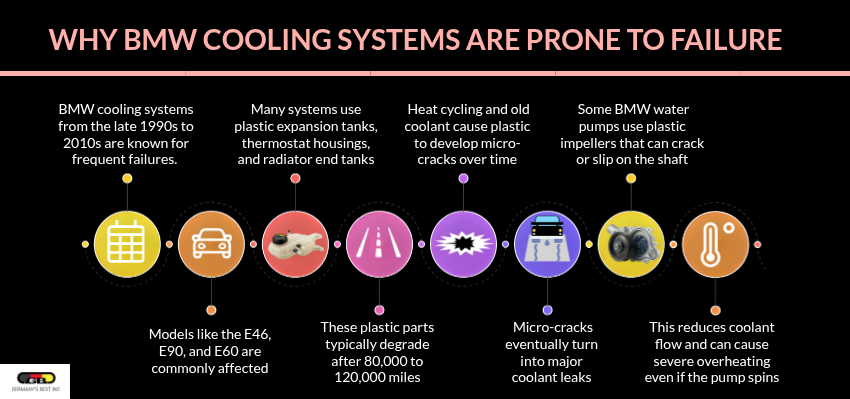
BMW cooling systems on models from the late 1990s through the 2010s — including the E46, E90, E60, and their variants — are notorious for using plastic coolant expansion tanks, plastic thermostat housings, plastic water pump impellers, and plastic radiator end tanks. While these components are engineered to function well when new, they are highly susceptible to degradation after 80,000 to 120,000 miles of use. The combination of repeated heat cycling and the slightly acidic nature of degraded coolant causes the plastic to develop micro-cracks that eventually grow into full leaks.
The water pump on many BMW models adds another layer of vulnerability. Some BMW water pumps use a plastic impeller blade that can crack and spin freely on the pump shaft without providing any actual coolant circulation — a condition that leads to severe overheating even though the pump appears to be turning.
Signs Your BMW Cooling System Is Failing
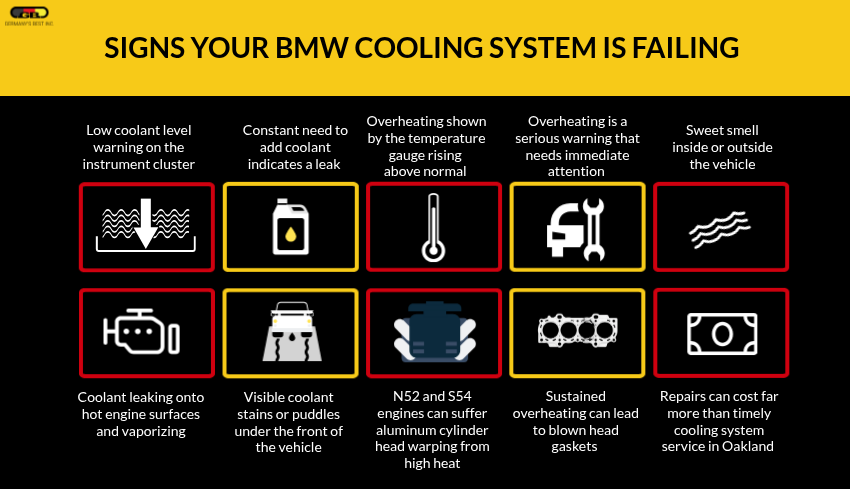
One of the most important warning signs is a low coolant level warning on your instrument cluster. If you are consistently adding coolant to your BMW, something in the system is leaking. Overheating — indicated by the temperature gauge climbing above normal — is a more serious warning that demands immediate attention. Some BMW owners notice a sweet smell inside the cabin or outside the vehicle, which indicates coolant is leaking onto hot engine surfaces and vaporizing. Visible coolant staining or puddles under the front of the vehicle are also clear indicators of a cooling system problem.
Never ignore an overheating BMW. The N52 and S54 engines, among others, have aluminum cylinder heads that can warp under sustained high temperatures, leading to blown head gaskets and repair bills that far exceed the cost of a timely cooling system service in Oakland.
Common BMW Cooling System Components We Replace
At Germany’s Best, INC., our technicians regularly replace coolant expansion tanks, thermostats and thermostat housings, radiators with plastic end tanks, water pumps with upgraded metal or improved impeller designs, coolant hoses, and the radiator cap. On models where the coolant flush interval has been missed, we also perform a full system flush and refill with BMW-approved blue coolant to restore the proper chemistry and corrosion inhibitors in the system.
Our BMW Cooling System Service Approach
When you bring your BMW to us, we perform a thorough pressure test of the cooling system to identify any active or potential leak points. Our team of European auto mechanics checks the coolant condition, evaluates the water pump, and inspects all plastic components for signs of cracking or degradation. We then present a complete assessment and recommend replacing components proactively when we see signs of imminent failure — because it is always more cost-effective to address multiple cooling components during a single service visit than to have your vehicle towed back a month later with a different failure.
Address: 5291 College Ave, Oakland, CA 94618
Phone: (510) 658-8948
Website: germanysbestinc.com
Frequently Asked Questions
Q: How often should I flush the coolant in my BMW?
A: BMW recommends a coolant flush every two years or approximately 30,000 miles, though this can vary by model. Fresh coolant maintains the proper pH level and protects aluminum components from corrosion.
Q: Can I use any type of coolant in my BMW?
A:No. BMW requires a specific OAT (Organic Acid Technology) coolant, typically the blue BMW coolant. Using the wrong coolant can cause internal corrosion, gasket damage, and water pump failures. Always use BMW-approved coolant or a compatible equivalent
Q: Why is my BMW overheating even though I just added coolant?
A: If your BMW is overheating despite having adequate coolant, the most likely cause is a water pump with a failed impeller that is not circulating coolant, a stuck thermostat, or a blockage in the radiator. Bring your vehicle to Germany’s Best for a complete diagnosis.
Q: Is it worth replacing the cooling system on a high-mileage BMW?
A: Absolutely, as long as the engine itself is sound. A comprehensive cooling system overhaul on a high-mileage BMW typically costs far less than engine repair from overheating damage, and it extends the useful life of the vehicle significantly.
 Mon – Fri: 8:00 AM to 5:00 PM
 5291 College Avenue in Oakland, CA 94618
 510-658-8948