


Quick Takeaways:
- Audi’s 2.0T TFSI EA888 Gen 1 and Gen 2 engines have a documented oil consumption issue related to piston ring design affecting 2008-2013 models.
- Consuming more than 1 quart per 1,000 miles is abnormal and should be investigated rather than simply topped off between services.
- Valve stem seals and PCV system failure contribute to oil consumption alongside piston ring wear on higher-mileage TFSI engines.
- Audi issued Technical Service Bulletins and extended warranty coverage on some affected model years.
- Germany’s Best, INC. at 5291 College Avenue in Oakland provides comprehensive Audi oil consumption diagnosis and repair options.
Oakland’s Audi community — the A4s and Q5s and TTs that navigate the College Avenue corridor through Rockridge, the I-580 MacArthur Maze approach from the Bay Bridge, the Park Boulevard run through the Dimond District toward Leimert, and the Piedmont Avenue stretch through Temescal — includes a significant number of pre-2013 2.0T TFSI models that carry a documented oil consumption issue. Germany’s Best at 5291 College Avenue in Rockridge has been serving Oakland and the surrounding East Bay since 1991 and knows this engine’s consumption characteristics intimately. Many Oakland Audi owners have quietly developed the habit of checking and adding oil between services without investigating why the level drops — a habit that is understandable and worth examining before the consumption rate or the underlying cause progresses further.
Why do Audi 2.0T TFSI engines consume so much oil in Oakland?
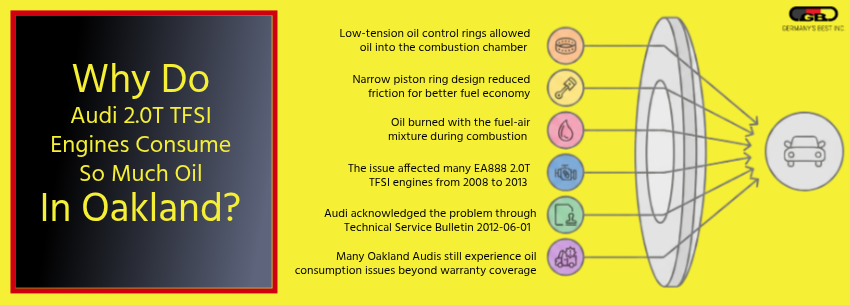
The first and second generation EA888 2.0T TFSI engines used a piston ring design with a narrow, low-tension oil control ring intended to reduce friction and improve fuel economy. The engineering tradeoff was that this ring allowed oil from the crankcase side to pass into the combustion chamber where it burned off with the fuel-air mixture. This was a systematic design characteristic affecting a broad population of vehicles produced from approximately 2008 to 2013.
Audi acknowledged the issue through Technical Service Bulletin 2012-06-01, which provided extended warranty coverage for ring pack replacement on qualifying vehicles. Many Oakland-area Audis are now beyond that coverage window, but the consumption issue persists in engines that were not repaired. Germany’s Best at 5291 College Avenue can check whether your specific vehicle is still covered under any remaining coverage period. Schedule an Audi oil consumption diagnostic at Germany’s Best, INC. in Oakland.
How much oil consumption should concern Oakland Audi owners?
Audi’s published specification allowed up to 0.5 liters per 1,000 km — approximately one quart per 1,200 miles. Independent Audi specialists consistently consider this threshold too generous for a modern engine in good condition. A healthy Audi should use no more than one quart per 3,000 to 5,000 miles under normal driving.
If you are adding oil every 1,500 to 2,000 miles — whether you notice it checking the dipstick in the Rockridge BART parking lot or at the Lake Merritt Saturday Farmers Market — the consumption rate warrants investigation. Oakland’s year-round consistent driving climate means these engines accumulate mileage without seasonal breaks, and consumption-related wear progresses accordingly. Get Audi repair in Oakland, CA today.
What other factors contribute to Audi TFSI oil consumption besides piston rings?
The PCV (positive crankcase ventilation) system is the third most common contributing factor after piston rings and valve stem seals. A malfunctioning CCV unit allows oil mist to enter the intake manifold rather than being separated and returned to the sump. This contributes to both oil consumption and carbon buildup on intake valves simultaneously.
Valve stem seals that have hardened and cracked with age allow oil from the valve train to drip into the intake port during deceleration. The signature symptom is a puff of blue smoke specifically on cold startup and on deceleration after sustained driving on I-580 or I-880 — the moments when intake vacuum is highest.
What are the repair options for Audi TFSI oil consumption at Germany’s Best?
Repair options depend on the specific diagnosis. PCV system replacement addresses the intake oil mist contribution and is the most affordable starting point. Valve stem seal replacement can be accomplished without a full engine teardown on most TFSI engines using a specialized tool that holds valves against their seats with compressed air. Piston ring replacement requires a complete engine teardown. Germany’s Best at 5291 College Avenue provides a complete diagnosis with clear repair options before any decision is made.
Germany’s Best has been serving Oakland and the East Bay from their Rockridge location at 5291 College Avenue since 1991, with ASE-certified master technicians who have over 15 years of experience with German vehicles.
Frequently Asked Questions
Q: Which specific Audi models and years are most affected by TFSI oil consumption?
A: Audi A4, A5, Q5, and TT models with the 2.0T TFSI EA888 engine produced from approximately 2008 to 2013 are the primary group. Germany’s Best at 5291 College Avenue can confirm the consumption profile for your specific model year.
Q: Does Germany’s Best, INC. serve other East Bay communities besides Oakland?
A: Yes — Germany’s Best serves drivers from throughout the East Bay, including Berkeley, Emeryville, Piedmont, Alameda, and the surrounding communities.
Q: Does Germany’s Best, INC. service other German brands besides Audi?
A: Yes — Germany’s Best specializes in all German-engineered vehicles, including BMW, Mercedes, Volkswagen, and Porsche, alongside Audi. Contact the shop at (510) 658-8948 to confirm service availability.
Q: How long has Germany’s Best been serving the Oakland and East Bay community?
A: Germany’s Best, INC. has been serving Oakland and the East Bay from 5291 College Avenue since 1991 — over 30 years of German vehicle expertise for the Rockridge and East Bay community.
 Mon – Fri: 8:00 AM to 5:00 PM
 5291 College Avenue in Oakland, CA 94618
 510-658-8948