


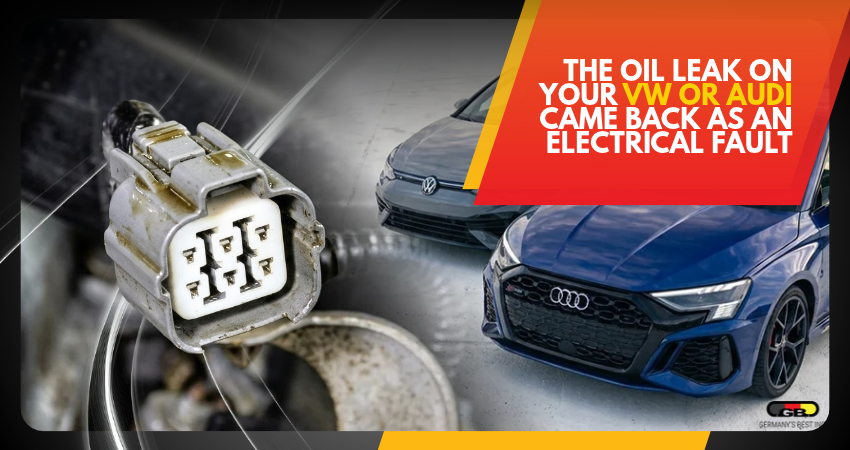
A crankshaft position sensor code that returns a week after the sensor was replaced is usually not a bad part. On a VW or Audi it is often engine oil, sitting inside the connector and in the first few inches of wire behind it.
Almost nobody looks for that failure, because it does not present as a leak. It presents as a sensor that keeps failing, a module that reads nonsense, or a fault that moves around the car and never settles anywhere long enough to be diagnosed.
Where the oil actually goes once it escapes
Stranded copper wire is a wick. Tiny channels run between the individual strands, insulation seals the outside, and capillary action does the rest. Dip the end of a loom in oil and the oil will climb it, slowly, in the direction of whatever is cooler and lower in pressure.
On a VW or Audi four-cylinder that usually means a sensor sitting in or near an oily environment: the crankshaft position sensor at the back of the block, the camshaft sensor on the head, an oil level or oil pressure switch, or a connector routed along the side of the sump where a weeping pan seam drips onto it.
What the oil does once it is inside a connector
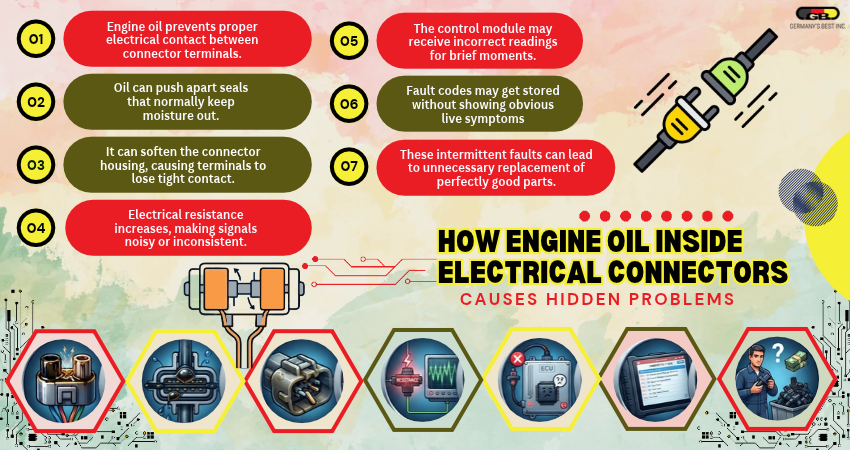
Engine oil is not a conductor, which sounds reassuring and is the wrong way around. Damage comes from oil preventing proper contact, pushing apart the seal that was keeping moisture out, and softening the connector housing so the terminals no longer sit tight against each other.
What follows is intermittent and maddening to chase. Resistance climbs a little, a signal gets noisy, and the control module sees a reading that makes no sense for a fraction of a second. You get a stored fault with no obvious live symptom, and that is the kind of thing that gets a perfectly good part thrown at it.
It does not stop at the sensor
Left long enough, oil keeps climbing. The loom that leaves a cam sensor runs toward the engine control module, and the module’s own connector is the end of the road. Control units turn up with oil pooled in the bottom of the case and corrosion on the board where the oil carried moisture in with it.
A flooded module is a different conversation from a gasket. A module that has been flooded usually needs replacing and then coding to the car. Coding and programming is work we do here, and all of it is avoidable if the leak that started it gets dealt with early.
The oil that never comes back
Nobody counts engine leaks directly. The nearest public measure is what happens to the oil the state buys. CalRecycle’s figures for 2024 show 90.5 million gallons of lubricating oil sold in California and 70.2 million gallons recycled. That recycled total is built from hauler manifests and recycler reports, so oil that burned inside an engine, stayed in a drum, or escaped past a tired seal never appears in it.
How to spot it before the module pays for it
Pull the connector on any sensor that has thrown a repeat code and look inside it with a light. Oil shows as a wet film on the terminals and a dark stain creeping along the wire insulation where it enters the plug. Squeeze the loom a few inches back: a wicked harness feels soft and slightly swollen compared with a dry one.
Age matters here too. Connector seals harden over the years, so a leak a newer car would have shrugged off gets inside an older one immediately, and the same seep on a 2006 Passat and a 2021 Q5 produces very different outcomes.
If oil is present, replacing the sensor is pointless on its own. The connector needs replacing, the affected section of wire needs cutting back to dry copper, and the leak feeding it has to be closed. Oil also finds the gap in a split loom cover, so any protective sleeve in the area gets opened and checked.
Why Oakland cars see more of it than you would think
Two local habits make this worse. Hills are the first: a car parked nose-down on a College Avenue side street holds oil at the front of the engine overnight, and a car parked nose-up holds it at the back, so a seep that would spread out on flat ground concentrates on whatever is lowest.
Second is the stop-and-go run across to Berkeley or Emeryville, which keeps underhood temperatures high and oil thin without ever giving the engine a long enough run to dry out the crankcase. Thin oil finds its way through a tired seal more easily, and the colder, damper months add condensation inside the same connectors.
Bring Us the Fault That Keeps Coming Back
If a sensor on your Audi or Volkswagen has been replaced once and failed again, let us open the connector before you buy another one.
Germany’s Best Inc. — 5291 College Ave, Oakland, CA 94618
 Mon – Fri: 8:00 AM to 5:00 PM
 5291 College Avenue in Oakland, CA 94618
 510-658-8948
