


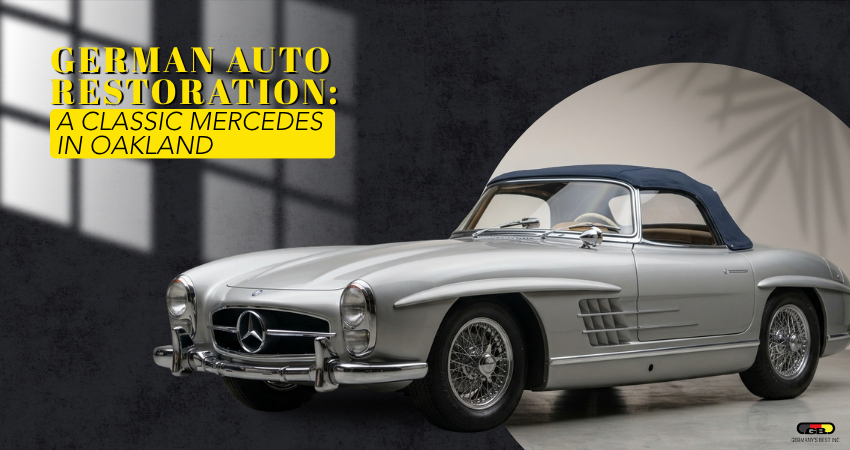
That W123 300D in the garage or the R107 SL under a cover deserves better than a general mechanic guessing at 40-year-old systems. Classic Mercedes restoration is its own craft. The engines, the mechanical fuel injection, the wiring, none of it works like a modern car, and the parts and know-how are getting rarer every year here in Oakland. Ask around town.
Good restoration work rewards patience and real skill. The U.S. Bureau of Labor Statistics projects about 67,000 job openings a year for automotive service technicians through 2032, and very few of those new techs ever train on carbureted or mechanically injected classics. It pays to find a shop that isn’t learning your car on your dime. Pick carefully.
Quick Summary: Key Takeaways
- Fuel systems first: Many classic Benzes use Bosch K-Jetronic mechanical injection that most modern shops never touch.
- Cooling is critical: Original radiators and water pumps on a W123 or W126 need attention before you drive it hard.
- Wiring gets brittle: Decades-old harness insulation cracks and causes gremlins that only patient diagnosis solves.
- Rust and trim: Bay Area cars fare better than Rust Belt ones, but chrome, seals, and body seams still need care.
- Original parts matter: Correct Mercedes parts protect how the car runs and what it’s worth later.
Classic Mercedes restoration is a different skill than modern repair
Working on a classic Benz has almost nothing in common with plugging a scan tool into a new one. Take a W113 Pagoda, a W123 diesel, or an R107 SL: mechanical fuel injection, points or early electronics, and systems you read by feel and gauge instead of by fault code. Experience is the tool here. Our techs have spent years with Bosch K-Jetronic, hydraulic valve trains, and vacuum-operated everything, which is exactly what a car from the 1970s or 80s needs from the shop that touches it. There is no shortcut.
A proper restoration starts with fuel, cooling, and electrics
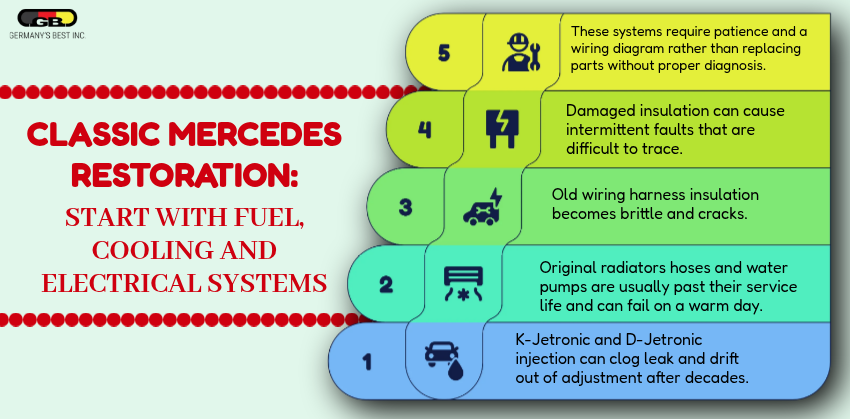
Most classic Mercedes projects begin in the same three places. The fuel system comes first, since K-Jetronic and D-Jetronic injection tends to clog, leak, and drift out of adjustment after decades. Cooling is next, because the original radiators, hoses, and water pumps are usually well past their life and will let go on a warm day when you least want them to. Then the wiring. Old harness insulation goes brittle and cracks, causing the faults that come and go and drive owners crazy, and sorting it takes patience and a diagram rather than a parts cannon.
Age, heat cycles, and neglect are what these cars fight
Time is the real enemy of a classic Mercedes, not miles. Rubber fuel lines harden, injection seals shrink, and cooling systems silt up whether the car is driven daily or parked for years. Sitting still hurts. Oakland helps in one way. The mild Bay Area climate near College Avenue spares these cars the road-salt rust that destroys East Coast Benzes. Coastal salt air and long storage still attack the chrome, seals, and brake lines that no one has touched in twenty years.
Rushing or cutting corners ruins a classic’s value
A classic Mercedes is worth more when it’s done right and worth less when it’s botched. Wrong parts hurt twice. Mismatched paint or a hacked-in modern fuel pump costs you on reliability and on resale. Correct parts hold value. A W126 or a Pagoda restored with correct components and careful attention to the cooling and fuel systems will run and hold its value far better than one patched together with whatever fit. That’s why we source proper parts and write down every step. Cheap fixes show.
Germany’s Best has restored German classics in Oakland for decades
We’ve specialized in German cars in Oakland for over 25 years, and classic Mercedes work is close to our heart. That’s rare now. Our ASE Master and Bosch-certified techs handle K-Jetronic tuning, cooling overhauls, engine repair, and the fiddly electrical sorting these cars demand, right on College Avenue in Rockridge, and we serve Berkeley, Emeryville, and Piedmont owners too. Tell us the car and the goal, a full restoration or a careful revival, and we’ll give you an honest plan and honest parts.
Frequently Asked Questions
Q: How much does a classic Mercedes restoration cost?
A: There’s no flat rate. It depends on the car and the goal, since a mechanical revival costs far less than a full body-off restoration. We inspect the car first, then give you a staged plan so you can put fuel, cooling, and safety ahead of paint and chrome.
Q: Can you fix Bosch K-Jetronic fuel injection?
A: Yes. K-Jetronic, also called CIS, is common on 1970s and 80s Mercedes, and we service and adjust it regularly. Most modern shops avoid it. We know it well and can dial it back in.
Q: Is it worth restoring an old Mercedes?
A: Often, yes, especially desirable models like the W113 Pagoda, R107 SL, or a clean W123 diesel. Done with correct parts, a restoration makes the car run better and holds its value. We’ll tell you straight before you commit.
Q: Where can I get a vintage Mercedes serviced near Oakland?
A: Germany’s Best on College Avenue services and restores classic Mercedes for owners across Oakland, Berkeley, Emeryville, and Piedmont. We pair ASE Master and Bosch certification with decades of hands-on time on older German cars.
Start your classic Mercedes project in Oakland
Got a vintage Benz that deserves a proper revival? Bring it to a shop that has restored German classics for over 25 years. Reach out. We’ll walk through a realistic, honest plan for your car.
Hours: Mon–Fri 8:00 AM–5:00 PM; Sat–Sun Closed
Website: germanysbestinc.com
 Mon – Fri: 8:00 AM to 5:00 PM
 5291 College Avenue in Oakland, CA 94618
 510-658-8948