


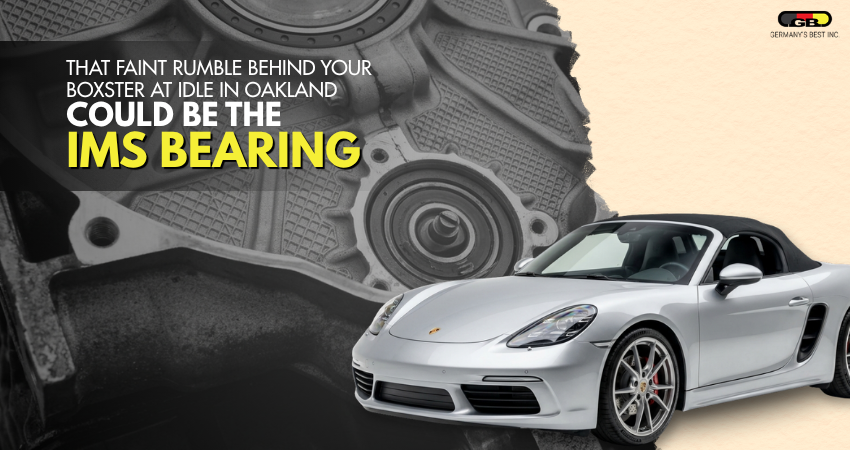
Sit in a 996 or a 986 Boxster with the engine warm, windows down, on a quiet block off College Avenue. Listen behind you. A low rumble, or a light chatter that comes and goes at idle — and vanishes the moment you touch the clutch on a manual car — is the sound Porsche owners lose sleep over. That’s the intermediate shaft bearing. The IMS. It lives inside the engine.
Germany’s Best has specialized in German cars on College Avenue for over 25 years, and Porsche IMS work is part of what we do. Autumn is a good time to look at it, because this is the season when Oakland owners pull the car out for a drive up Skyline and finally hear what a warm summer of short trips has been doing quietly.
Quick Summary: Key Takeaways
- What the IMS does: the intermediate shaft drives the camshaft chains, and its bearing supports that shaft inside the engine case.
- Which engines: the M96 and M97 flat-sixes in the 1997–2008 Boxster, Cayman and 911, with the highest concern on single-row bearing cars.
- The warning signs: a rumble at idle that changes with clutch position, metallic glitter in the oil filter, or a small oil seep at the bellhousing.
- Failure is catastrophic, not gradual: when the bearing lets go, debris goes through the whole engine.
- Inspection is straightforward: oil filter and drain-plug analysis plus a listen is how the conversation starts, not with a teardown.
The intermediate shaft is buried, and that is the problem
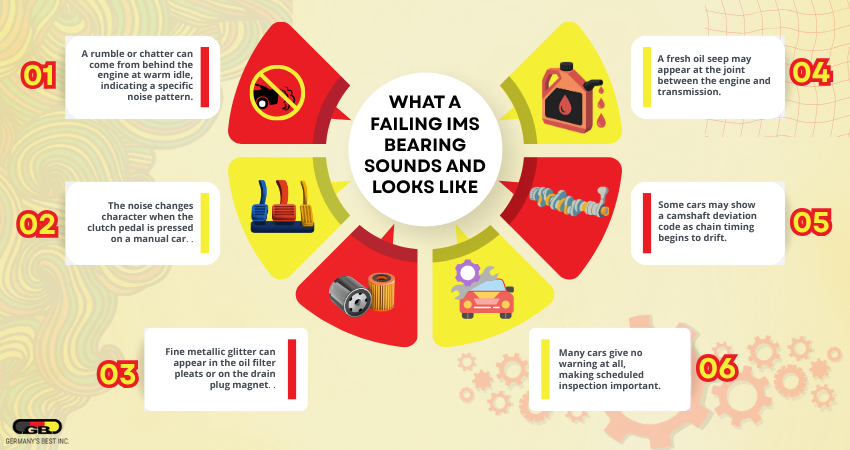
Porsche’s flat-six drives its camshaft chains from an intermediate shaft running the length of the engine case. That shaft needs a bearing at each end. The rear one hides behind the flywheel.
Because it’s inside the case, it lives in oil but gets very little of it moving through — a sealed bearing with a grease charge and a hard duty cycle is a poor combination over decades. When the seal degrades, oil and combustion contaminants get in, the grease is gone, and the bearing starts wearing at a rate nobody can see from outside.
You can’t inspect it visually. Not without the transmission out.
What a failing IMS bearing sounds and looks like
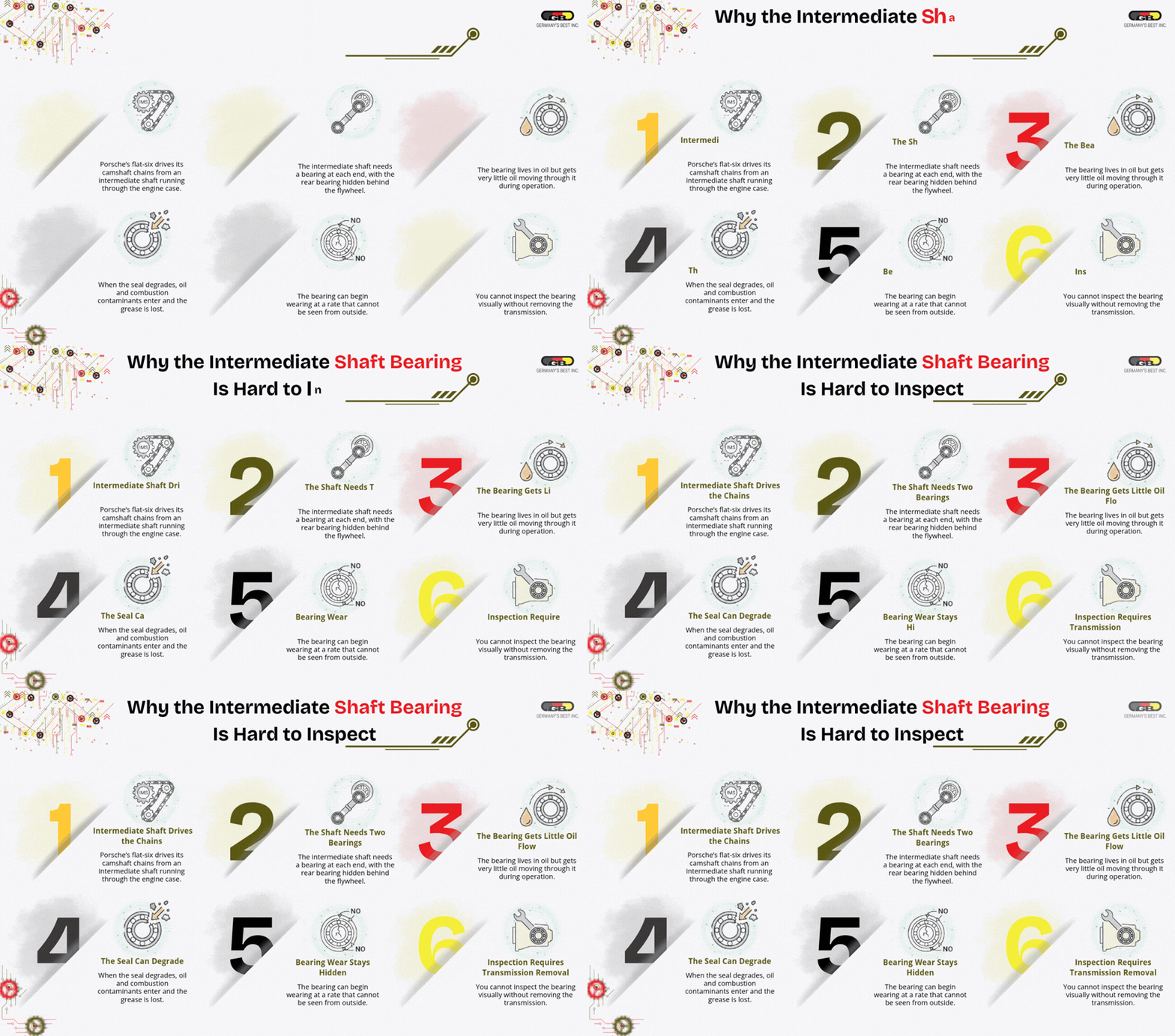
Noise comes first, and it’s specific. A rumble or chatter from behind the engine at warm idle that changes character the instant you press the clutch pedal on a manual car.
Beyond that, evidence comes out of the oil rather than the exhaust. Fine metallic glitter in the oil filter pleats or on the drain plug magnet is the single most useful early sign we look for, and a fresh oil seep at the joint between engine and transmission belongs on the list too. Some cars throw a camshaft deviation code as chain timing drifts. Many give no warning at all, which is exactly why owners of these cars should be looking on a schedule instead of waiting.
Which Porsches carry the risk
It’s an engine question, not a mileage one. The M96 and M97 flat-sixes used in the Boxster, Cayman and 911 from roughly 1997 through 2008 are the ones under discussion.
Inside that range, the single-row bearing fitted to many 2000–2005 cars draws the most concern, while the dual-row earlier design and the later larger bearing carry different risk profiles — and the 2009-on direct-injection engines dropped the arrangement entirely. If you own a car in that window and nobody has told you which bearing you have, that’s the first thing worth establishing.
Waiting is a bad bet on this particular part
Most wear items give you notice. This one often doesn’t. When it fails, the debris field goes everywhere the oil goes.
AAA fielded more than 27 million roadside assistance calls in 2024, and about 13 million of those vehicles had to be towed, according to AAA’s 2025 car care release. An IMS failure is a tow, and it’s usually a tow at the worst possible moment. Our advice is unglamorous: check the oil evidence at every service, and address the bearing while the engine is still healthy rather than after it isn’t.
How we approach IMS work at our Oakland shop
We start with evidence. Cut the filter open, inspect the pleats, read the drain plug magnet, listen warm and cold, then check the data for chain-timing deviation.
If the findings point at the bearing, the job requires the transmission out to reach it, so we look at the clutch, the rear main seal and the flywheel at the same time — separating a gearbox twice makes no sense. Our technicians are ASE Certified Master Technicians and the shop is BOSCH certified, and we’ll tell you honestly what we found rather than selling fear. Some cars need the work now. Some need a re-check at the next service.
Frequently Asked Questions
Q: What are the symptoms of a failing Porsche IMS bearing?
A: A rumble or chatter at warm idle that changes when you use the clutch, metallic particles in the oil filter or on the drain plug, an oil seep at the bellhousing, and sometimes a camshaft timing deviation code. Many failures give little warning, so oil inspection matters.
Q: Which Porsche engines have the IMS bearing problem?
A: The M96 and M97 flat-sixes in the 1997–2008 Boxster, Cayman and 911. Concern is highest on the single-row bearing used in many 2000–2005 cars. The 2009-on direct-injection engines use a different design.
Q: How can I tell if my IMS bearing is going bad without taking the engine apart?
A: Oil analysis is the practical answer. Cutting the filter open and inspecting the drain plug magnet at every oil service reveals bearing material long before the noise gets loud, which is why we do it as a matter of course on these cars.
Q: Is IMS bearing replacement worth doing preventively?
A: On an M96 or M97 car you plan to keep, yes — particularly if the transmission is coming out anyway for a clutch. Set against the cost of an engine that has swallowed bearing debris, it’s an easy call.
Have your Porsche looked at in Oakland this autumn
If your Boxster, Cayman or 911 rumbles at idle, or you’ve never had the oil filter cut and inspected, start there. Bring the car to College Avenue and we’ll show you what comes out of it.
Germany’s Best Inc. — 5291 College Ave, Oakland, CA 94618
Hours: Mon–Fri 8:00 AM – 5:00 PM; Sat–Sun closed
Website: germanysbestinc.com
 Mon – Fri: 8:00 AM to 5:00 PM
 5291 College Avenue in Oakland, CA 94618
 510-658-8948
