


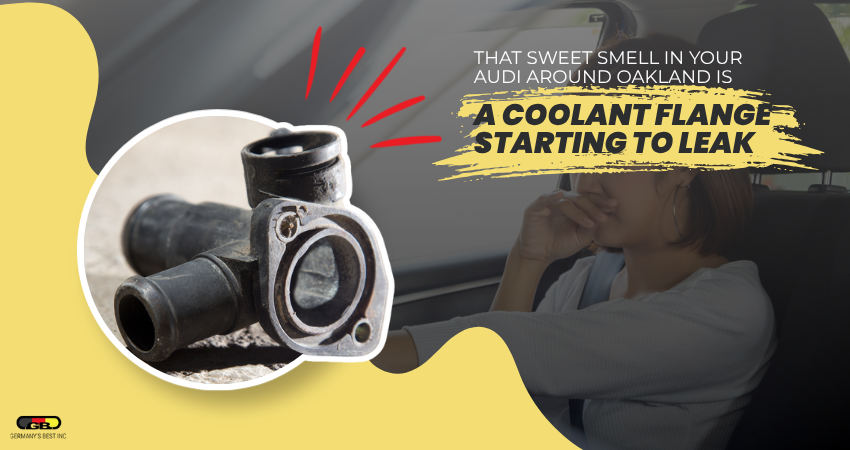
You catch it at a red light on College Avenue. A faint maple-syrup smell drifts through the vents, the temperature needle nudges past center in the July heat, and two days later the low-coolant light blinks on. Trouble.
That is an Audi coolant flange starting to weep. The flange is a cheap plastic fitting at the back of the cylinder head, and Oakland’s summer traffic is exactly what pushes a hairline crack into a steady leak. Left alone, a $60 part can cook a head gasket that costs thousands. So get it checked before your next drive out I-580.
Quick Summary: Key Takeaways
- Trust the smell: A sweet, syrupy odor and a creeping temp gauge usually mean coolant is escaping a cracked flange.
- The flange is plastic: Audi’s coolant flange and O-rings go brittle after 60,000-plus miles and years of heat cycles.
- Heat exposes it: Oakland’s 90-degree afternoons and I-580 stop-and-go turn a slow weep into a real leak.
- Don’t top off and hope: Running low on coolant risks a $2,500-plus head gasket, not a $60 flange.
- We test, then fix: A pressure test finds the exact leak before we replace the part with the correct pink G13 coolant.
The Sweet Smell and Low-Coolant Light Are the First Clues
The first sign is your nose. Audi coolant carries a sweet, almost maple scent, and when the flange weeps, you smell it through the vents before any warning light ever comes on. Watch the gauge too. On a healthy Audi, the needle sits dead center, but when coolant runs low it drifts up on hills and in traffic, then swings back down once you are moving and air pours through the radiator.
Look under the car. You might find a thin pink film near the front of the engine, or crusty residue where a hose meets the head. Catch it there, and the repair stays small.
Why Audi Coolant Flanges Crack in Oakland’s Summer Heat
The flange fails because it is plastic sitting in a hot, pressurized system. Audi molds a coolant flange and O-rings at the back of the cylinder head on the 2.0T and the 3.0 and 3.2 V6, and after eight or ten summers the plastic goes brittle while the seal shrinks. Heat is the accelerant. Every time the engine warms past 200 degrees and cools overnight, the part expands and contracts until a hairline crack opens along a molded seam.
Oakland is no Sacramento. But a string of 85-to-90-degree days off College and Broadway is plenty to finish off a 90,000-mile flange. Coolant is cheap. The flange is cheap. The engine it protects is not.

I-580 and I-880 Stop-and-Go Is Where a Weeping Flange Lets Go
Cooling systems fail under load. On the open freeway, airflow through the radiator keeps things in check, but sit on I-580 through the MacArthur Maze or grind up I-880 toward the tube at 5 p.m., and coolant temps climb while the electric fans fight to keep up. That pressure spike turns a slow weep into a puddle.
AAA expected to rescue 7.7 million drivers over the summer of 2025, and overheating is one of the top reasons a car ends up on the shoulder. An Audi losing coolant in stop-and-go is a prime candidate. Don’t be one of them.
Driving an Audi Low on Coolant Risks the Head Gasket
Heat damage compounds fast, so a leak you ignore rarely stays just a leak. Once the coolant level drops far enough, the engine cannot shed heat, and the aluminum head warps the moment temperatures spike past their limit. A coolant flange and O-ring set is usually $150 to $350 installed. Small money.
Let it run low and overheat, though, and you are into a head gasket, maybe a warped head, at $2,500 to $4,500 on a modern Audi and sometimes more. The math is not close. Top-offs only mask the problem while the crack grows wider. If the gauge climbs into the red, pull over and shut it off.

How We Find and Fix a Coolant Flange Leak
We start with a cooling-system pressure test, not a guess. Pressurizing the system cold shows us exactly where coolant escapes — the flange, a hose, the thermostat housing, or the water pump — so you pay to fix the real fault instead of a parade of parts. Then we replace the failed flange and O-rings with the correct Audi components, refill with the specified pink G13 coolant, and bleed the air out so you do not get a false overheat later.
Most flange jobs go out the same day. You get an inspection report with photos, so you see the cracked part we pulled. No mystery, no upsell.
Why Oakland Audi Owners Bring Cooling Problems to Us
We are a German-only shop on College Avenue, and Audi cooling work is bread and butter here. We know these cars. Drivers from Rockridge, Berkeley, Emeryville, and Piedmont bring us the cars the dealer quotes a fortune on, and our technicians hold ASE Master and Bosch certifications after more than 25 years on European marques.
We use factory-grade diagnostic tools and OEM parts, and we tell you what is urgent versus what can wait. Straight answers. Dealer-level work. No dealer markup.
Frequently Asked Questions
Q: What does a coolant flange leak smell like on an Audi?
A: Sweet, like maple syrup or warm antifreeze. It is usually strongest through the vents or when you open the hood after a drive. Audi coolant is pink, so you may also see pink drips or dried residue near the back of the engine. If you smell it and the temp gauge is creeping up, have the cooling system pressure-tested before you drive far.
Q: How much does it cost to fix an Audi coolant flange in Oakland?
A: Most coolant flange and O-ring replacements run about $150 to $350 installed, depending on the engine and how buried the part is. That is cheap next to the $2,500-plus a head gasket costs after an overheat. Catching the leak early is what keeps the bill small.
Q: Can I keep driving my Audi with a small coolant leak?
A: It is a gamble. Short local trips may be fine for a day or two if you watch the level closely, but a small weep can become a real leak without warning, and one bad overheat on I-880 will warp the head. Get it looked at instead of topping off coolant week after week.
Q: What coolant does my Audi need?
A: Newer Audis use the pink G13 or G12evo coolant, not the generic green stuff. Using the wrong coolant can gel or corrode the system. We refill with the specified Audi coolant and bleed the air out so the gauge reads true.
Get Your Audi’s Cooling System Checked in Oakland
Smell coolant or watching the needle climb? Bring your Audi in before your next trip out I-580.
Website: germanysbestinc.com
 Mon – Fri: 8:00 AM to 5:00 PM
 5291 College Avenue in Oakland, CA 94618
 510-658-8948