


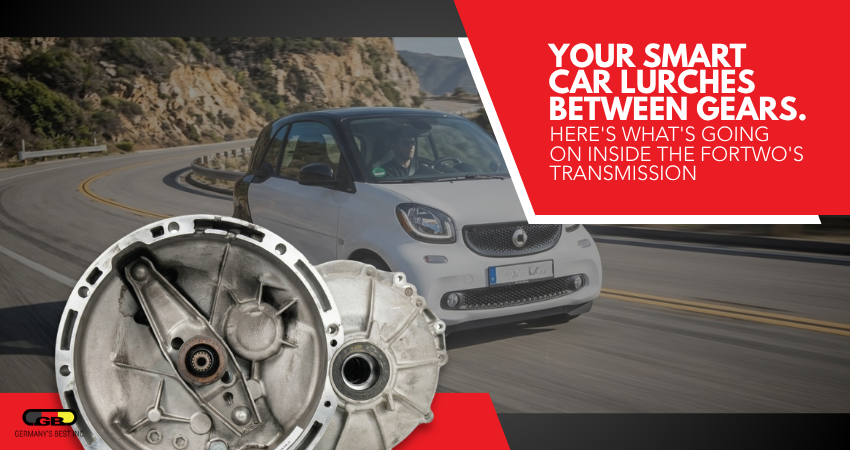
Every gas fortwo sold in the U.S. from 2008 to 2015 nods its head on each upshift, and that much is normal. A smart car transmission that has started lurching harder, slipping or stalling out of first is a different matter. Those cars use an automated manual: an ordinary clutch and gearbox worked by electric actuators instead of your foot. In Oakland, where College Avenue turns into a parking lot through the holidays, a tired actuator or a clutch that needs relearning shows up fast. Get it looked at before the December rush, while it’s still a nuisance.
Quick Summary: Key Takeaways
- Know your generation: 2008–2015 is an automated manual; 2016–2017 is a dual-clutch automatic or a manual.
- Some lurch is built in: a mild nod on every shift is normal.
- Test the actuator first: it’s an electric motor that works the clutch, and its faults feel like a worn clutch.
- Clutch work needs a teach-in: new parts must be programmed in.
Which Fortwo You Have Decides Your Smart Car Transmission
Model year tells you which gearbox you’re dealing with. EPA’s fueleconomy.gov lists the 2015 smart fortwo coupe with a 1.0-liter three-cylinder and an “Automatic (AM5),” rated 34 mpg city. AM stands for automated manual. That’s the 451 generation.
The 2016–2017 cars are another animal. EPA lists them with a 0.9-liter turbo and either a five-speed manual or an “Automatic (AM6),” which Mercedes-Benz USA sold as the twinamic dual-clutch. After 2017, U.S. fortwos went electric only. This post is mostly about the 451 and its automated manual.
Normal Head-Nod Versus a Real Fault
A 451 pauses between gears because the actuator has to open the clutch, change gear and close it again, all while the engine’s power is briefly cut off from the rear wheels. So the car nods. Ease off the throttle a little as it shifts and the nod mostly disappears, the same way you’d lift with a manual.
Real smart car transmission problems feel different. Harsh engagement from a stop, revs flaring between gears, a shudder in first, or a transmission warning on the dash all point past “that’s how they drive.” Compare it with last month. If the shifts have changed, something inside has too.
The Clutch Actuator Gets Tested Before the Clutch
On the 451, an electric clutch actuator does the job of your left foot, so it belongs on the test list before any clutch gets quoted. A weak actuator or a corroded connector can make the car slip, bang into gear or hesitate to pull away, and from the driver’s seat that feels exactly like a worn clutch. Test before buying parts.
The reverse mistake costs more. A new clutch fitted to a car with a failing actuator still won’t engage cleanly, so the money goes in and the lurch stays. Shifting trouble that comes and goes is worth reporting early, while it’s still intermittent.
Clutch Adaptation, the Teach-In Step
The control unit must learn the bite point. That’s adaptation, often called a teach-in, and it’s done with a diagnostic tool after a clutch, actuator or control unit is replaced. It isn’t optional. Skip it and the car can engage roughly or slip.
Clutch wear moves the bite point too. So a fortwo that has grown jerkier over a year sometimes needs its adaptation checked before anyone talks about parts. The order matters: test the actuator, confirm the clutch, then relearn, because a relearn can’t fix a motor that’s failing.
Holiday Traffic Is Where a Weak Gearbox Shows Up
Stop-and-go is the hard part. Every creep forward from a standstill is a clutch engagement, and a run down College Avenue past Rockridge BART on a December Saturday can mean dozens of them. Add the backed-up approach to the Bay Bridge and a worn actuator gets no rest.
That’s when a borderline car gives up. Better to find out in a service bay on College Avenue, with a technician watching the data, than stuck in the bridge queue with a car that won’t take a gear. Owners coming in from Berkeley are a short drive up the same street.

How Germany’s Best Checks a Smart Gearbox
Data comes first in any smart car transmission repair. Germany’s Best has served Oakland for over 25 years with ASE-certified master technicians, and its transmission process covers full-system scanning, live transmission data, a road test under load and adaptation checks. Smart cars get their coding and calibrations done in-house.
That matters on a fortwo. A clutch swapped without reading the transmission data or running the teach-in can leave you with a car that still lurches, and now with a bigger bill behind it.
Frequently Asked Questions
Q: Why does my smart car jerk when it shifts gears?
A: On 2008–2015 models, the automated manual opens the clutch for every shift, so a mild nod is normal. Harder jerks, slipping or flaring revs usually point to the clutch actuator, a worn clutch, or an adaptation that needs relearning.
Q: What is a smart car clutch teach-in?
A: It’s the adaptation routine that teaches the transmission control unit where the clutch engages, run with a diagnostic tool after any clutch or actuator work and whenever engagement has drifted as the clutch wears.
Q: What does a smart car clutch actuator do?
A: On 2008–2015 fortwos, it’s the electric motor that opens and closes the clutch for every shift in place of a clutch pedal. When it weakens, the car can slip, shift harshly or hesitate from a stop, the same symptoms a worn clutch gives.
Q: Does the 2016 smart fortwo have the same transmission?
A: No. U.S. 2016–2017 fortwos came with a five-speed manual or the twinamic dual-clutch automatic, which is different hardware from the earlier automated manual.
Have the Fortwo Checked Before the December Rush
Note when the lurch happens. Pulling away, mid-shift, or only once the car is warm? Each one points somewhere different. Type the answer into the message field of the contact form on germanysbestinc.com, then plan the drop-off at 5291 College Avenue, Oakland, CA 94618, before the holiday traffic on that street gets any worse.
 Mon – Fri: 8:00 AM to 5:00 PM
 5291 College Avenue in Oakland, CA 94618
 510-658-8948
